When you specify a sintered neodymium magnet for an industrial application, the material grade and dimensional tolerances often receive the most attention. Yet the coating you choose can determine whether that magnet delivers consistent performance over years or fails within months. Rare earth magnet coatings are not an afterthought-they are a critical engineering decision that directly impacts product reliability, safety, and lifecycle cost.
At Jinconn Magnet, we see this firsthand. Every week, engineering teams contact us after experiencing premature flux loss or mechanical failure traced back to inadequate surface protection. The corrosion mechanism is well understood: NdFeB magnets contain neodymium-rich grain boundary phases that react readily with moisture, forming neodymium hydroxide and causing volume expansion that leads to micro-cracking and irreversible performance degradation. This is why selecting the right rare earth magnet coating solution matters as much as selecting the right grade.
Why Uncoated NdFeB Magnets Present a Risk
Sintered NdFeB magnets offer outstanding energy density, but their chemical composition makes them vulnerable. Neodymium has a standard electrode potential of -2.431 V, making it highly reactive, while the electrochemical potential difference between the grain boundary phase and the Nd₂Fe₁₄B matrix accelerates corrosion in humid environments.
Without a reliable protective layer, even short-term exposure to ambient moisture can initiate corrosion along grain boundaries. This explains why passivation treatments, while useful for storage and transport, are rarely sufficient for long-term service. Passivated magnets typically offer only 3 to 6 months of storage stability at 22°C and 60% humidity. For products destined for automotive, marine, or outdoor applications, you need durable rare earth magnet coatings designed for the operating environment.

Common Rare Earth Magnet Coating Options
Different applications demand different protection strategies. Jinconn offers a range of coating systems, each with distinct performance characteristics.
Ni-Cu-Ni Triple Layer
This is the industry standard for general-purpose use. The three-layer structure-nickel, copper, then nickel-provides a robust barrier against moisture and oxidation. The copper intermediate layer improves corrosion resistance by reducing porosity, while the outer nickel layer offers hardness and a smooth, bright finish.
Jinconn applies Ni-Cu-Ni coatings with precision thickness control, typically 10 to 20 μm total, to minimize air gap impact on magnetic performance. This coating works well for indoor electronics, sensors, and general industrial components. Salt spray resistance typically ranges from 48 to 96 hours under ASTM B117 testing.
Epoxy Coatings
For environments with high humidity, salt spray, or chemical exposure, epoxy-coated rare earth magnets deliver superior protection. Epoxy forms a tough polymer barrier that resists moisture ingress far better than metallic platings alone. Black epoxy coatings can achieve salt spray resistance exceeding 200 hours.
Jinconn offers both standard and high-build epoxy options, with thickness ranges from 15 to 30 μm. The coating also provides electrical insulation, which can be beneficial in motor and sensor applications. However, epoxy is more susceptible to mechanical damage from impact or abrasion compared to nickel plating.
Zinc Coatings
Zinc plating offers a cost-effective option for applications with moderate corrosion risk. Available in white, yellow, or black chromate finishes, zinc coatings provide basic protection at a lower price point. Salt spray resistance typically reaches 48 to 72 hours with trivalent passivation.
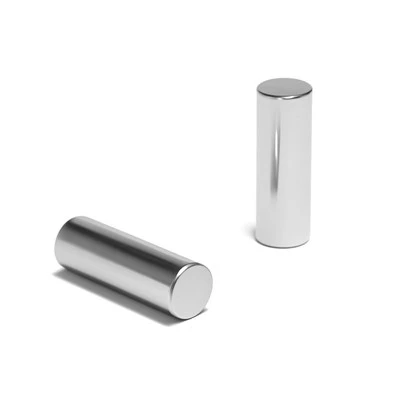
Jinconn supplies zinc-coated cylindrical magnets for structural components and cost-sensitive applications where environmental exposure remains limited. While suitable for indoor use, zinc coatings generally do not match the durability of epoxy or Ni-Cu-Ni in demanding conditions.
Specialized Coatings: Gold, Silver, and PVD Aluminum
For medical devices, aerospace systems, or high-end electronics, premium coatings offer distinct advantages. Gold overplating provides excellent biocompatibility and tarnish resistance, making it suitable for implantable or body-worn devices. Silver plating enhances electrical conductivity for grounding or signal transmission applications. PVD aluminum coatings deliver outstanding adhesion and corrosion resistance, often exceeding 500 hours in salt spray tests, with minimal thickness impact.
Jinconn supports these specialized rare earth magnet coating requirements for customers with unique performance needs, offering custom solutions beyond standard catalog offerings.
How Coating Selection Affects Magnetic Performance
A common concern among design engineers is whether the coating itself alters magnetic output. The answer depends on the coating material and thickness.
Nickel, being ferromagnetic, can confine magnetic flux lines within the coating layer, causing a measurable reduction in external field strength. Studies show that coercivity and remanence can decrease as coating thickness increases, and surface field intensity weakens accordingly. Copper and epoxy coatings, being non-magnetic, do not directly interfere with magnetic flux.
At Jinconn, we factor these effects into our engineering reviews. When you share your application requirements, we recommend coating types and thicknesses that balance corrosion protection with magnetic performance, ensuring your assembly meets both functional and durability targets.
The Jinconn Approach to Rare Earth Magnet Coatings
We treat coating application as a precision manufacturing step, not a secondary process. Our quality control protocols cover every stage: surface preparation to remove machining residues and contaminants, controlled deposition to achieve uniform thickness, and final inspection to verify coating integrity.
Jinconn's manufacturing capabilities include precision edge rounding before coating application. Sharp edges are smoothed to improve coating uniformity and reduce the risk of chipping during handling and assembly. For high-reliability applications, we apply nickel-based laser cladding to reinforce critical edges, forming a dense metallurgical bond that minimizes electrochemical corrosion risk.
Our ISO 9001-certified quality system ensures batch-to-batch consistency, with each production lot accompanied by a Certificate of Analysis detailing coating thickness measurements, salt spray test results, and magnetic performance verification.
Making the Right Choice for Your Application
The optimal rare earth magnet coating for your project depends on several factors:
Operating environment: Indoor, outdoor, marine, or chemical exposure?
Mechanical demands: Will the magnet face abrasion, impact, or vibration?
Thermal conditions: What is the maximum continuous temperature?
Dimensional constraints: How much coating thickness can your assembly tolerate?
Regulatory requirements: Does the application require biocompatibility or specific certifications?
Jinconn's engineering team supports customers through this decision process. We review your CAD drawings, operating conditions, and performance targets, then recommend coating solutions that align with your technical and commercial requirements.
Technical Consultation and Quote Requests
If you are developing a new magnetic assembly or evaluating an existing design, our engineering team can provide technical feedback and coating recommendations.
Custom manufacturing: Based on 2D/3D customer drawings
Quality management: ISO 9001 and ISO 14001 certified facilities
Services: Material selection, coating specification, prototype fabrication