Selecting the right cylindrical neodymium magnets for an electromagnetic assembly involves more than picking a part number from a catalog. The interaction between magnetic grade, dimensional ratios, and operating conditions directly determines whether a design succeeds or fails in real-world use. At Jinconn Magnet, we see this play out regularly: a well-specified cylindrical neodymium magnet delivers consistent flux and mechanical reliability, while a misjudged one leads to demagnetization, fit issues, or corrosion.
These high energy density cylindrical rare earth magnets are a powerful and adaptable solution for various home and industrial uses. They provide a compact yet reliable magnetic hold, making them ideal for crafting magnetic fittings, holding cabinet doors, or organising living and workspaces. In advanced technological fields, they are indispensable in the electronics sector, particularly within sensors and miniature motors, where their precise dimensions enhance efficiency and operational stability. They are also employed in the telecommunications industry, improving signal transmission and clarity in antenna systems. Thanks to their combination of strength, precision, and flexibility, these high grade cylindrical rare earth magnets are perfectly suited for everyday household projects as well as high-performance industrial applications.
This article breaks down the key technical trade-offs in selecting cylindrical neodymium magnets and explains how to match grade, size, and strength to your specific application needs.
Matching Magnetic Grade to Operating Temperature
The grade designation on a cylindrical neodymium magnet defines its maximum energy product (BHmax) and its maximum working temperature (Tmax). Standard grades from N35 to N54 deliver strong magnetic output under ambient conditions, typically below 80°C. For example, a typical N35-D5*20 cylindrical rare earth magnet offers a remanence (Br) of ≥11.8kGs, intrinsic coercivity (Hcj) of ≥12 kOe, and a surface magnetic field of approximately 4,300 Gs, with a magnetic flux of 2.0 mWb when tested with a fluxmeter.
However, using these standard grades in high-temperature environments-such as drive motors or industrial sensors operating above 80°C-carries a real risk of irreversible flux loss.
For elevated-temperature applications, high-temperature series grades (SH, UH, EH) offer a practical solution. These high-temperature cylindrical neodymium magnets include dysprosium or terbium additions that raise intrinsic coercivity (Hcj), helping maintain stable magnetic fields under continuous thermal load. A temperature-stable cylindrical neodymium magnet in SH or UH grade can operate reliably from 150°C up to 200°C, making it suitable for automotive systems, industrial automation, and renewable energy equipment.
Practical takeaway: If your assembly runs above 80°C, specify SH, UH, or EH grades rather than standard N-series. This simple choice prevents permanent demagnetization and extends service life.
Balancing Dimensional Ratios for Flux and Pull Force
Physical dimensions govern the practical pull strength and effective working distance of any cylindrical neodymium magnet. Diameter and length each play distinct roles:
Diameter: Increasing the pole surface area directly scales holding force when the magnet contacts a ferrous substrate.
Length or thickness: Greater axial length projects the magnetic field deeper into the air gap-critical for proximity sensors and non-contact couplings.
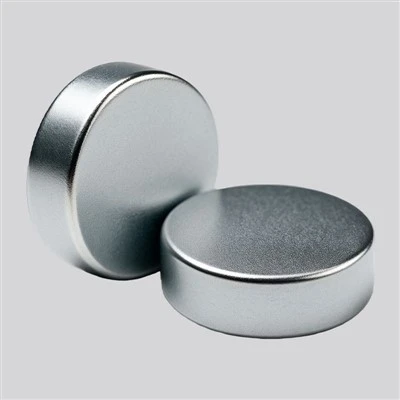
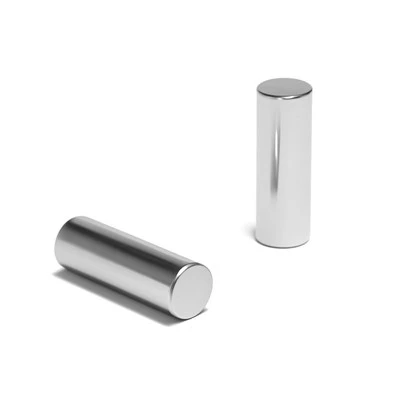
The length-to-diameter ratio (*L/D*) also matters. A very thin disc-shaped cylindrical neodymium magnet has a low permeance coefficient (Pc), making it susceptible to self-demagnetization in open-circuit configurations. Conversely, a rod-style cylindrical neodymium magnet with a higher *L/D* ratio maintains flux more effectively in air-gap applications.
For precision assemblies-medical pumps, robotic joints, aerospace actuators-accumulated dimensional tolerances can cause unacceptable flux variation. That's why Jinconn manufactures precision cylindrical neodymium magnets with machining tolerances held to ±0.01mm, ensuring consistent field output across production batches.
Practical takeaway: Match the *L/D* ratio to your working distance. Use larger diameters for direct-contact holding force and longer lengths for gap-sensitive sensing applications.
Protective Coatings: Durability in Real-World Environments
Sintered NdFeB contains iron and rare-earth elements, so uncoated cylindrical neodymium magnets oxidize rapidly. Coating failure directly reduces magnetic output over time, especially in humid or outdoor environments.
| Coating Type | Typical Thickness | Salt Spray Resistance (ASTM B117) | Common Applications |
|---|---|---|---|
| Ni-Cu-Ni (triple-layer) | 10–20 μm | 48–96 hours | Indoor electronics, general industrial use |
| Epoxy (black or clear) | 15–30 μm | Up to 200 hours | Marine environments, high humidity, outdoor units |
| Zinc (Cr3+) | 8–15 μm | 24–48 hours | Cost-sensitive structural parts |
A corrosion-resistant cylindrical neodymium magnet with epoxy coating suits demanding environments where moisture exposure is constant. For encapsulated designs or secondary overmolding, phosphate passivation offers a temporary protective layer during assembly.
Practical takeaway: Select your coating based on environmental exposure, not just cost. A durable cylindrical neodymium magnet with appropriate coating maintains performance longer and reduces replacement frequency.
The OEM Advantage: Custom vs. Catalog
Standard catalog magnets have fixed dimensions, grades, and orientations, which may not align with your assembly requirements. For OEM engineering teams, working with a manufacturer that offers custom cylindrical neodymium magnets provides distinct advantages:
| Parameter | Standard Catalog | Jinconn Custom OEM |
|---|---|---|
| Dimensional limits | Fixed stock sizes | Machined to customer CAD |
| Tolerance range | Typically ±0.05 to ±0.10 mm | Precision grinding to ±0.01 mm |
| Grade options | Mostly ambient N-series | SH, UH, EH high-temperature grades available |
| Magnetization vector | Fixed axial or radial | Custom multi-pole or skewed orientation |
| Secondary assembly | Bare magnets only | Integrated sub-assemblies (magnet + housing) |
This is especially relevant for applications requiring high-strength cylindrical neodymium magnets with specific magnetic field distributions or mechanical interfaces. Jinconn supports CAD files in STEP (.stp), IGES (.igs), and 2D drawings in PDF or DWG format, enabling direct translation from design to production.
Manufacturing Process and Quality Assurance
Jinconn follows a rigorous manufacturing workflow to ensure every high-grade cylindrical rare earth magnet meets performance and durability standards:
Raw Material Preparation – High-purity neodymium, iron, boron, and selected alloying elements (such as dysprosium or terbium for high-temperature grades) are carefully weighed according to precise composition formulas. Strict control of chemical purity is essential to ensure consistent magnetic properties.
Vacuum Melting and Strip Casting – The prepared raw materials are melted in a vacuum induction furnace to prevent oxidation. The molten alloy is then rapidly solidified using a strip casting process, forming thin alloy flakes with uniform microstructure. This step ensures homogeneity and improves subsequent magnetic performance.
Hydrogen Decrepitation (HD) – The cast alloy flakes undergo hydrogen decrepitation, where hydrogen gas penetrates the alloy and causes it to fracture into coarse powder. This process improves powder brittleness and prepares the material for fine milling while maintaining magnetic integrity.
Pre-Packing Inspection – All NdFeB magnets are inspected for appearance, dimensions, coating integrity, and magnetic performance. Only qualified products proceed to packing.
Demagnetization or Magnetic Isolation – If required, magnets are demagnetized before packing. For magnetized products, magnetic shielding or spacing is applied to prevent mutual attraction and damage.
Surface Protection – Each magnet is separated using plastic sheets, foam, or paper spacers to avoid chipping, scratching, or coating damage.
Common Industrial Applications
Automotive systems: Steering angle sensors, throttle position actuators, auxiliary electric pump drives-all rely on reliable cylindrical neodymium magnets with stable output across temperature variations.
Industrial automation: Servomotor rotors, pneumatic cylinder position sensors, and robotic grippers use precision cylindrical neodymium magnets for consistent force and repeatability.
Consumer electronics: Miniature acoustic transducers, haptic feedback actuators, and camera module positioning benefit from compact strong cylindrical neodymium magnets with high energy density.
Renewable energy and power: Tachometers, flow meter turbines, and wind sensor arrays require weather-resistant cylindrical neodymium magnets that hold up under outdoor exposure.

Technical FAQ
Q1: How does temperature affect NdFeB magnet performance?
Temperature directly impacts both flux output and irreversible flux loss. As temperature rises, the magnetic flux density (Br) and intrinsic coercivity (Hcj) decrease. If the operating temperature exceeds the maximum rated temperature for the chosen grade, the magnet may suffer permanent demagnetization. For applications above 80°C, high-temperature grades such as SH, UH, or EH are recommended.
Q2: What is the difference between intrinsic coercivity (Hcj) and coercivity (Hcb), and why does it matter?
Coercivity (Hcb) is the reverse field required to reduce the magnet's flux density to zero. Intrinsic coercivity (Hcj) is the reverse field required to completely demagnetize the material. Hcj is the more meaningful metric for thermal stability: a higher Hcj indicates better resistance to demagnetization at elevated temperatures. This is why high-temperature grades specify higher Hcj values.
Q3: What lead time can I expect for custom prototype samples based on my drawings?
A: Prototypes generally take 7 to 10 working days, depending on material availability, coating requirements, and tolerance specifications.
Q4: Can you supply integrated magnet assemblies rather than bare magnets?
A: Yes. Jinconn assembles magnets into stainless steel, brass, aluminum, or plastic housings using structural adhesives or press-fitting per your design.
Q5: What quality documentation accompanies shipments?
A: Each lot includes a Certificate of Analysis (CoA) with dimensional inspection reports, magnetic performance metrics (Gauss/Flux), and coating thickness verification.
Q6: Do you support small-volume prototype orders before full production?
A: Yes. We offer flexible production scheduling, allowing customers to order prototype quantities for testing before committing to volume manufacturing.
Final Thoughts
Selecting the correct cylindrical neodymium magnets requires balancing grade, geometry, coating, and tolerance against your application's thermal and environmental demands. A high-performance cylindrical neodymium magnet isn't just about the highest N-rating-it's about the right combination of material, dimensions, and protection for your specific operating conditions.
At Jinconn Magnet, we manufacture engineered cylindrical neodymium magnets for OEM applications across automotive, industrial, consumer electronics, and renewable energy sectors. If you're developing a new magnetic assembly or refining an existing design, our engineering team can review your specifications and provide technical feedback.
Technical Consultation & Quote Requests
Custom manufacturing based on 2D/3D drawings
ISO 9001 and ISO 14001 certified facilities
Services: material selection, magnetic simulation, prototype fabrication
Contact Us:
Phone/WhatsApp/WeChat: +86 13829120676
Email: Info@jinconn.com
Address: Xiaohe Industrial Zone, Daojiao Town, Dongguan City, Guangdong Province, China