When developing a product that uses magnetic components, choosing the right magnet involves more than checking its diameter or magnetic grade. Engineers also need to consider how the magnet fits into the assembly, how it interacts with nearby components, and what performance it must maintain during operation.
For products with limited installation space or specific magnetic requirements, rare earth circular magnets offer a flexible solution. Their round geometry makes them suitable for different mechanical structures, while NdFeB materials provide strong magnetic properties in a relatively compact size.
However, standard specifications do not always match an OEM product's requirements. Custom dimensions, magnetization direction, surface protection, and material grade may all need adjustment. This article explains the main points to consider when specifying circular rare earth magnets for a new product or an existing assembly.
Choosing Magnets Based on Application Needs
Before choosing a magnet, engineers should define what they expect it to do. A circular magnet used to hold two components together has different requirements from one used for position detection or motor operation.
For example, a magnetic fastening system may focus on holding force and installation space. A sensor application, on the other hand, may require a specific magnetic field at a certain distance. Meanwhile, motor applications often involve more detailed requirements for pole arrangement, magnetization direction, and operating temperature.
These differences affect the magnet specification from the beginning.
When evaluating high-performance rare earth circular magnets, consider the following questions:
• Does the magnet provide attraction, positioning, sensing, or another function?
• How much space is available for installation?
• What magnetic force or field strength does the assembly require?
• Will the magnet work with steel, another magnet, or non-magnetic materials?
• Does the application involve vibration, heat, or moisture?
•Defining these conditions early helps engineers avoid selecting a magnet based on grade or size alone.
Custom Magnet Shapes for Different Assembly Needs
Circular magnets are available in several configurations. Although they share a round profile, their structures can serve different installation and functional requirements.
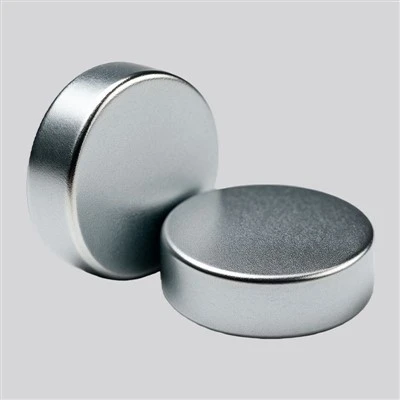
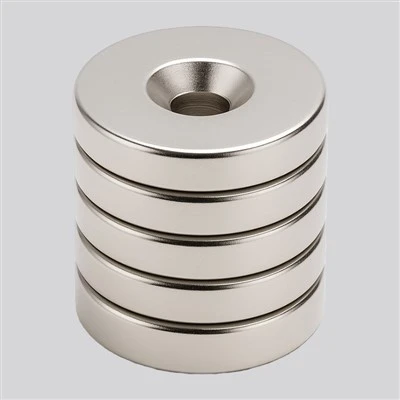
A solid disc magnet works for applications that need a flat circular magnetic component. A ring magnet includes a central opening for a shaft, fastener, or other mechanical part. For screw-mounted assemblies, a countersunk magnet provides an angled hole that accommodates a compatible flat-head screw.
The choice depends on the surrounding structure and mounting method.
For custom size rare earth circular magnets, customers can specify the outer diameter, inner diameter, thickness, hole dimensions, and other relevant features. Engineers may also need to define edge details and the space between the magnet and adjacent components.
A technical drawing provides a clearer reference than a general size description. If a drawing is not available, a physical sample or 3D model can also help communicate the required structure.
Matching Magnet Performance to Product Requirements
NdFeB magnets are widely used when an application requires strong magnetic performance from a relatively small component. Nevertheless, the selected grade should match the working conditions.
Several material properties deserve attention:
• Remanence (Br) indicates the residual magnetic flux density of the material. It helps engineers compare the magnetic characteristics of different grades.
• Intrinsic coercivity (Hcj) relates to resistance to demagnetization. This property becomes particularly relevant when the magnet operates in a demanding magnetic or thermal environment.
• Maximum operating temperature depends on the selected grade and application conditions. If the assembly experiences elevated temperatures, a suitable high-temperature grade may be necessary.
• Magnetization direction determines the orientation of the magnetic poles. Axial, diametrical, and other magnetization arrangements can produce different magnetic field distributions.
For this reason, precision rare earth circular magnets should be evaluated as part of the complete magnetic system. In some applications, magnetic simulation or prototype testing can help verify whether the proposed specification meets the intended requirements.
Technical Details to Confirm Before Ordering
Incomplete specifications often make it difficult to evaluate a custom magnet accurately. Buyers can make the quotation and technical review process more efficient by providing several key details.
|
Required information |
What to provide |
|
Magnet geometry |
Disc, ring, countersunk, or other circular design |
|
Dimensions |
Diameter, thickness, hole size, and critical features |
|
Material grade |
Required NdFeB grade or magnetic performance |
|
Magnetization |
Axial, diametrical, or specified pole arrangement |
|
Surface coating |
Nickel, zinc, epoxy, or other requested finish |
|
Working environment |
Operating temperature, humidity, and exposure conditions |
|
Order quantity |
Prototype quantity and estimated production demand |
These details give the manufacturer a practical starting point for evaluating material selection, manufacturing feasibility, and inspection requirements.
If some specifications remain undecided, customers can explain the intended application and provide a drawing or sample first. The engineering team can then review the available information and discuss the remaining technical details.
Circular Magnet Applications Across Different Industries
The combination of round geometry and NdFeB magnetic properties makes circular magnets suitable for various product designs.
In consumer electronics, they can support attachment, alignment, and internal positioning. In motors and automation equipment, disc and ring magnets may form part of rotating or positioning assemblies. Sensors and instruments can also use circular magnets to generate a magnetic field for detection and measurement.
Meanwhile, countersunk designs provide a mounting option for products that require screw fastening. This is useful when the magnet needs to remain securely attached to a structural surface.
For each application, custom circular neodymium magnets should match the product's mechanical structure and magnetic function. The required specification may differ significantly between two products, even when both use magnets with similar dimensions.
Jinconn's Custom NdFeB Magnet Capabilities
Founded in 2011, Jinconn manufactures NdFeB permanent magnets and custom magnetic assemblies for customers in automotive, consumer electronics, industrial automation, and renewable energy. The company also provides magnetic circuit design to support different product and engineering requirements.
Customers can specify the dimensions, material grade, magnetic properties, magnetization direction, and surface coating according to their applications. Jinconn also works with different circular magnet designs, including thin discs, rings, and countersunk magnets for screw-mounted assemblies.
To discuss a project, customers can share their drawings, samples, or basic application details. Even if the final specifications are not yet available, information such as the intended function, installation space, operating conditions, and estimated quantity can help determine a suitable starting point.
Contact Jinconn to discuss custom rare earth circular magnets for your product requirements.