When sourcing permanent magnets for industrial applications, understanding the types of rare earth magnets available is essential for making the right procurement decision. Not all magnets perform the same way under different temperatures, environmental conditions, or mechanical stresses. For procurement engineers and product developers, selecting the right magnet type directly affects product reliability, cost, and long-term performance.
Key Takeaways
| 🧲 Two main families exist | Rare earth magnets fall into two categories: Neodymium (NdFeB) and Samarium Cobalt (SmCo). Each has distinct properties . |
| 🌡️ Temperature tolerance varies | SmCo magnets handle higher temperatures (up to 350°C), while standard NdFeB grades are limited to around 80°C . |
| 🛡️ Corrosion resistance differs | NdFeB magnets oxidize rapidly without coating; SmCo offers superior corrosion resistance . |
| 🔧 Manufacturing process affects performance | Sintered magnets offer maximum strength; bonded magnets allow complex shapes but with lower magnetic output . |
| 📊 Grade selection matters | Different grades (N35–N52, with temperature suffixes) suit different operating conditions . |
The Two Main Families of Rare Earth Magnets
The types of rare earth magnets used in commercial applications fall into two primary families: Neodymium-Iron-Boron (NdFeB) magnets and Samarium-Cobalt (SmCo) magnets . While both contain rare earth elements, they offer different performance characteristics that suit different applications.
Neodymium Magnets (NdFeB)
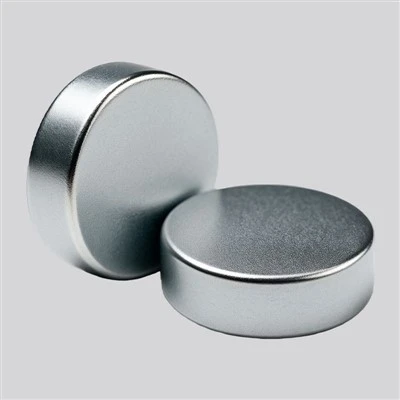
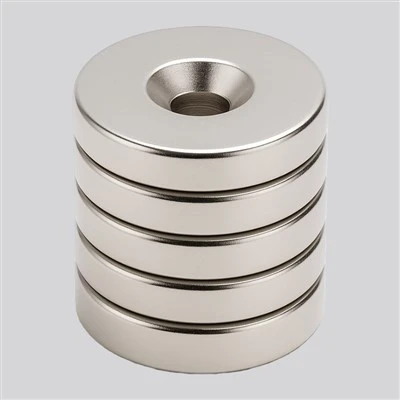
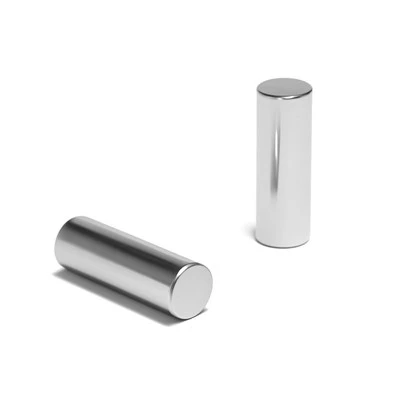
Neodymium magnets, often referred to as NdFeB magnets, are the strongest commercially available permanent magnets . They are composed primarily of neodymium, iron, and boron, with additional elements such as dysprosium or terbium added to enhance temperature stability .
Sintered NdFeB Magnets
Sintered NdFeB magnets are produced through a powder metallurgy process. They offer the highest magnetic energy product among all magnet types, with maximum energy products ranging from 30 to 59 MGOe . The manufacturing process involves:
•Melting and alloying raw materials
•Crushing and milling to fine powder
•Pressing in a magnetic field
•Sintering at high temperatures
•Machining to final dimensions
•Coating for corrosion protection
These magnets are widely used in electric vehicle motors, wind turbines, industrial automation, and consumer electronics .
Bonded NdFeB Magnets
Bonded NdFeB magnets are produced by mixing magnetic powder with a polymer binder. While they offer lower magnetic strength than sintered magnets, they can be molded into complex shapes and are more cost-effective for mass production . They are commonly used in precision electronic products such as headphones, sensors, and hard disk drives .
NdFeB Temperature Grades
NdFeB magnets are available in different temperature grades, indicated by suffix letters:
| Grade Suffix | Maximum Operating Temperature | Typical Applications |
|---|---|---|
| No suffix (N) | 80°C | General indoor applications |
| M | 100°C | Small motors and speakers |
| H | 120°C | Industrial actuators |
| SH | 150°C | Electric vehicle motors |
| UH | 180°C | Wind turbine generators |
| EH | 200°C | Aerospace and high-heat applications |

Samarium Cobalt Magnets (SmCo)
Samarium cobalt magnets were developed in the 1960s and remain an important option among the types of rare earth magnets for high-temperature and corrosive environments . They come in two main alloy varieties:
SmCo 1:5 Series
The original samarium cobalt alloy, containing approximately 37% samarium and 63% cobalt, offers energy products between 16 and 22 MGOe. This series provides excellent corrosion resistance as it contains no iron .
SmCo 2:17 Series
The more common and stronger SmCo alloy, containing about 25% samarium, 5% copper, 18% iron, and small amounts of hafnium or zirconium, with energy products between 24 and 32 MGOe . This series can operate at temperatures up to 350°C and offers far superior corrosion resistance compared to NdFeB .
Comparing the Types of Rare Earth Magnets
| Property | NdFeB Magnets | SmCo Magnets |
|---|---|---|
| Magnetic Strength | Higher (up to 59 MGOe) | Lower (up to 34 MGOe) |
| Maximum Operating Temperature | 80–200°C | Up to 350°C |
| Corrosion Resistance | Poor (requires coating) | Good to very good |
| Cost | Lower | Higher |
| Brittleness | Very brittle | Brittle but more durable |
| Typical Applications | EV motors, consumer electronics, wind turbines | Aerospace, medical devices, military, high-temperature sensors |
Manufacturing Process Variations
Beyond the two main material families, the types of rare earth magnets also differ by manufacturing process. Sintered magnets offer the highest magnetic performance but are limited in shape complexity. Bonded magnets allow for intricate geometries and are suitable for high-volume production, though with reduced magnetic output . For demanding industrial applications requiring maximum strength and consistent performance, sintered magnets are the standard choice.
Selecting the Right Type for Your Application
Choosing among the different types of rare earth magnets depends on several factors:
•Operating temperature is often the primary consideration. For applications exceeding 150°C, SmCo magnets are generally preferred, while NdFeB magnets offer higher strength at room temperature .
•Environmental conditions also matter. NdFeB magnets require protective coatings in humid or chemically aggressive environments, while SmCo magnets offer superior corrosion resistance without coating .
•Cost and availability influence the decision as well. NdFeB magnets are more cost-effective and widely available, while SmCo magnets command higher prices . For most commercial applications, NdFeB provides the best value, with SmCo reserved for specialized high-temperature or mission-critical applications .
Jinconn Magnet: Your Partner for All Types of Rare Earth Magnets
Jinconn Magnet has manufactured high-performance NdFeB permanent magnets and rare earth magnetic solutions since 2011. With over 15 years of experience, we offer the full range of types of rare earth magnets-sintered NdFeB and bonded NdFeB-customized to your specific application requirements.
Our capabilities include:
•Custom manufacturing: Magnets produced to your drawings and specifications, with grade options from N35 to N56 and temperature-stable variants (M, H, SH, UH, EH)
•Coating and protection: Multi-layer Ni-Cu-Ni coatings, epoxy, zinc, and specialized coatings for corrosion resistance
•Engineering support: Early-stage consultation to review designs, recommend material grades, and optimize magnetic performance
•Quality management: ISO 9001 and IATF 16949 certified, with full traceability and testing
•Magnet assembly: Bonding, overmolding, and precision integration for complex assemblies
We serve industries including automotive, consumer electronics, industrial automation, renewable energy, medical technology, and aerospace. For customers developing new products, we provide customized magnetic solutions based on drawings, samples, or technical specifications.
Ready to Discuss Your Rare Earth Magnet Requirements?
Jinconn Magnet provides custom NdFeB magnets for brands that need to balance magnetic strength, dimensional accuracy, environmental durability, and production consistency.
📧 Email: Info@jinconn.com
📱 Phone/WhatsApp: +86 13829120676
📍 Address: Xiaohe Industrial Zone, Daojiao Town, Dongguan City, Guangdong, China