Standard magnets work well in many applications, but they may not fit every product structure. Some assemblies require curved profiles, angled edges, rounded corners, or other specific shapes. In these cases, custom shaped magnets allow manufacturers to match the magnet to the available space and the function it needs to perform.
For OEM manufacturers and product developers, the main challenge is finding a suitable balance between shape, magnetic performance, and manufacturing requirements. Jinconn supplies custom NdFeB magnets based on engineering drawings, samples, or application specifications, helping customers develop magnetic components for their products.
Designing Magnets Around Your Product Structure
The shape of a magnet often depends on how it fits into the surrounding components. For example, a motor assembly may require a magnet with a particular contour, while an automated mechanism may need a shaped component that fits into a limited mounting area.
Using a standard block or disc magnet may require changes to the original design. By contrast, custom shaped NdFeB magnets give engineers more flexibility when working with irregular spaces or specific structural requirements.
Before selecting a magnet, consider the available installation space, nearby components, and mounting method. A 2D drawing or 3D model can help communicate the required geometry. If the design already exists as a physical part, a sample can also provide useful reference information.
Setting Dimensional Requirements for Custom Magnets
The magnet's dimensions affect both its fit and its performance in the finished assembly. Therefore, a custom specification should identify the critical measurements, including length, width, thickness, corner radius, and any other features that affect installation.
Not every dimension needs the same tolerance. For example, a dimension that determines the fit inside a housing may require closer control than one that does not affect assembly. Setting these requirements clearly helps avoid unnecessary manufacturing complexity.
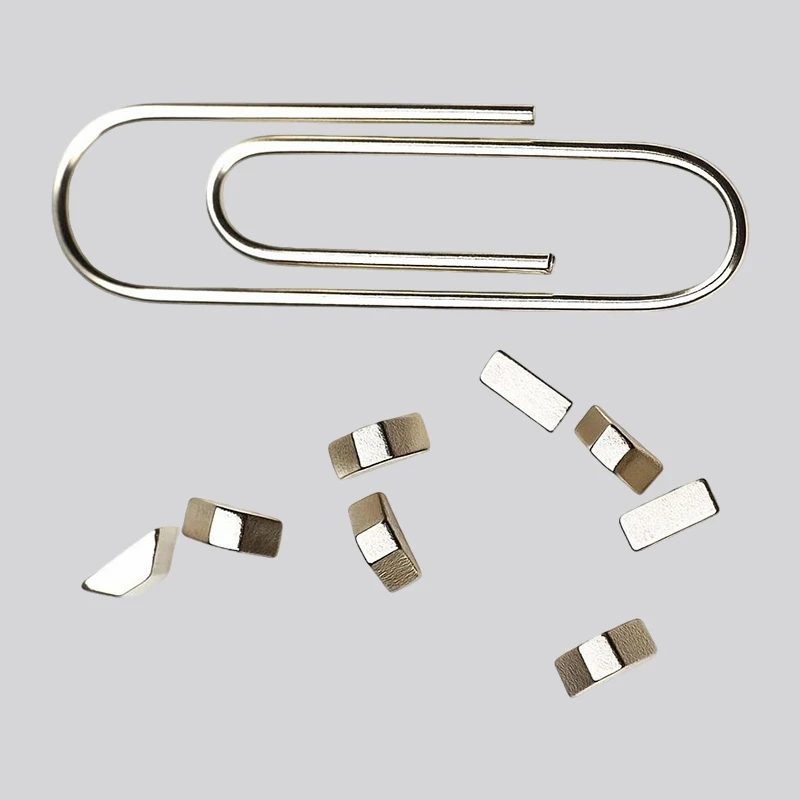
For precision custom shaped magnets, Jinconn can work from customer drawings, samples, and technical specifications. One example in the product range measures 8 × 6 × 4 mm with an R2 corner feature and specified dimensional tolerances of ±0.05 mm for length, width, and thickness.
These figures apply to that particular specification. Actual dimensions and tolerances should be confirmed against the final drawing and manufacturing requirements.
Matching Magnetic Properties to the Application
A magnet's shape is only one part of the selection process. Magnetic grade, magnetization direction, pole arrangement, and the distance between interacting components also influence performance.
NdFeB magnets suit applications that need strong magnetic properties within a relatively small space. However, choosing a higher grade does not automatically produce the desired result. Engineers should consider the complete magnetic circuit and the function of the component.
For example, high-strength custom shaped magnets may be suitable for certain motor assemblies, positioning mechanisms, and magnetic fixtures. Applications exposed to elevated temperatures may also require a grade with appropriate coercivity.
Jinconn offers customized NdFeB magnet specifications according to project requirements. One product specification uses N45 material, with remanence of at least 13.7 kGs and intrinsic coercivity of at least 12 kOe. Customers should confirm the required magnetic properties according to their operating conditions and assembly design.
How Custom Magnet Shapes Meet Different Application Needs
Shaped magnets are useful when a standard geometry cannot meet the structural or functional requirements of a product. Their applications vary depending on the equipment design and required magnetic performance.
Common applications include:
• Motors and drives: Magnets designed for specific motor and rotor configurations.
• Industrial automation: Components for positioning mechanisms, fixtures, and equipment assemblies.
• Sensors and instruments: Magnets used for detection, alignment, and other magnetic functions.
• Magnetic holding systems: Components integrated into custom mounting and clamping structures.
• Consumer electronics: Compact magnets for attachment, positioning, and selected internal mechanisms.
• Precision machinery: Specially shaped components for assemblies with limited installation space.
Each application has its own priorities. A motor component may require particular magnetic properties and temperature resistance, while a holding fixture may place more emphasis on dimensions and holding force. For this reason, custom shaped magnets for industrial applications should be specified according to the intended function rather than shape alone.
Temperature Limits and Coating Options for NdFeB Magnets
Operating conditions can affect the choice of both material and coating. NdFeB magnets may lose magnetic performance when temperatures exceed the suitable range for the selected grade.
If the application involves elevated temperatures, engineers should consider the maximum operating temperature and the magnet's resistance to demagnetization. A suitable high-temperature grade may be necessary, depending on the actual conditions.
Surface protection is another consideration. NdFeB materials can corrode in unfavorable environments, so the coating should suit the expected exposure and assembly process. Nickel-based and epoxy coatings are possible options, depending on the application.
For corrosion-resistant custom shaped magnets, customers should consider moisture exposure, contact with surrounding materials, and handling conditions before choosing a finish. These details help determine which coating is appropriate for the intended use.
Developing Magnets for Specific Product Requirements
Selecting a shaped magnet involves more than finding a suitable outline. The component must fit the assembly, deliver the required magnetic performance, and meet the manufacturing specifications for the finished product.
Jinconn supplies custom shaped magnets for OEM brands and industrial equipment manufacturers. Customers can provide drawings, samples, or application details to discuss dimensions, NdFeB grades, tolerances, magnetization direction, and coating options.
To start a project, share the intended application, available installation space, operating temperature, and key performance requirements along with your drawing or sample. This information provides a practical starting point for evaluating the magnet specification.
Contact Jinconn to discuss a custom shaped magnet for your product design.