
Product overview & Applicaion fields
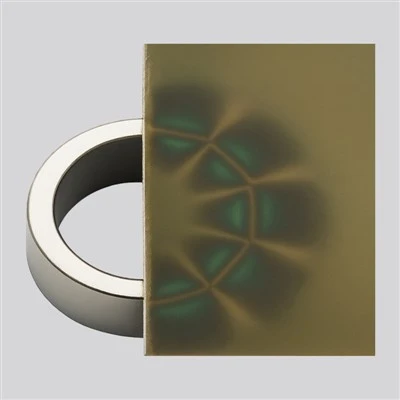
Precision customized heat resistant ring magnet is made from rare earth neodymium-iron-boron (NdFeB) material. It features strong magnetic force and stable performance. The central countersunk hole design allows for secure mounting using flat-head screws, compatible with metal, wood, plastic, and other materials. It offers firm installation, shock resistance, and is suitable for environments requiring frequent operation. Customized fast magnetic response heat resistant round nickle coating counterbore magnet offers high residual induction (Br), high intrinsic coercivity (Hcj), and excellent directionality. It is ideal for applications requiring strong magnetic adhesion and structural integration, including automation equipment, sensor systems, electro-mechanical assembly, positioning fixtures, and speaker mounting. It is a preferred magnetic component in engineering projects.

1.1 Application Examples
Specifically, for magnetic tool holders, the countersunk hole allows the magnet to be flush-mounted into panels, ensuring a concealed and visually clean finish. Moreover, this low noise operation precision customized heat resistant permanent round nickle plated countersunk magnet 's structure ensures that magnets can be securely fixed to a variety of materials-such as in concealed cabinet latches-delivering a seamless, stable, and reusable magnetic solution for various devices.
Techinical Specification
|
Product Name |
Heat Resistant ring magnets |
|
Magnet Grade |
N48 (Br ≥ 14.8 KGs, Hcj ≥ 10.5 KOe) - Customizable |
|
Dimensions |
D24-D21×4 mm |
|
Tolerance |
±0.05 mm (Length, Width, Thickness) |
|
Operating Temperature |
≤ 80°C (Customizable high-temp versions available) |
|
Density |
≥7.5 g/cm³ |
|
Surface Magnetic Field |
2400 Gauss (Measured using Japan TM-801 Gauss meter) |
|
Magnetic Flux |
2.2 mWb (Measured; value varies by material grade) |
Surface Treatment & Coating Technology
To improve corrosion resistance, surface quality, and long-term magnetic stability, this customized high-adhesion, heat-resistant nickel-plated ring magnet undergoes a series of advanced treatments:
Key Treatments
• Edge Reinforcement:
Laser cladding of a nickel-based alloy around the magnet's edges to seal micro-gaps and block electrochemical corrosion.
• Edge Rounding:
Precision chamfering to minimize magnetic field distortion and ensure smoother flux distribution.
Coating System
• Standard Coating:
Durable Ni–Cu–Ni triple-layer plating, with typical thickness:
Ni (3 μm) + Cu (5 μm) + Ni (4 μm).
Customized thicknesses available upon request.
• Optional Coatings:
Gold or silver plating for enhanced conductivity, corrosion protection, and premium appearance.

Standard Packaging Process
Step 1: Visual inspection of NdFeB magnets
Step 2: Separation to avoid magnetic attraction
Step 3: Anti-rust and moisture protection applied
Step 4: Inner packing with plastic bags or trays
Step 5: Outer carton packing and palletizing

Usage Precautions
- Handle with care to avoid chipping or cracking due to their brittle nature.
- Keep magnets away from electronic devices, magnetic storage media, and precision instruments.
- Avoid sudden attraction between magnets or with ferromagnetic materials to prevent injury.
- Use protective gloves during handling, especially for large or high-strength magnets.
- Store magnets with spacers and in a controlled environment
FAQ
Q1. How do you evaluate irreversible demagnetization risk under combined thermal and magnetic load?
Answer:Irreversible demagnetization is evaluated by combining elevated temperature exposure with external demagnetizing fields and time duration. Simulation of the operating load line against the B-H curve, followed by thermal aging and post-test flux measurement, is typically used to verify safety margins.
Q2. What causes early corrosion failure even when Ni-Cu-Ni coating is applied?
Answer:Common causes include incomplete edge coverage, micro-cracks at sharp corners, internal porosity in the sintered body, or galvanic corrosion at joints. Corrosion often initiates at edges rather than flat surfaces, making edge treatment and coating integrity critical.
Q3. How do rare earth composition adjustments affect coercivity consistency?
Answer:Adjustments in Dy or Tb diffusion improve coercivity but also increase sensitivity to process control. Uneven diffusion or grain boundary variation can lead to localized magnetic inconsistency, requiring strict control of diffusion depth and sintering parameters
We're here to help!
Phone/WhatsApp/WeChat: +86 13829120676
Email: info@jinconn.com
Website: www.jinconnmagnet.com
Address: Xiaohe Industrial Zone, Daojiao Town, Dongguan City, Guangdong, China
Hot Tags: heat resistant ring magnets, China heat resistant ring magnets manufacturers, factory, high temperature resistant ring magnets, High Remanence Ring Magnets, Strong Ring Magnets, professional grde ferrite ring magnets, radial ring magnet, Nickel Plating Ring Magnets