Choosing the right Radially Magnetized Ring Magnets is not simply a matter of selecting the strongest NdFeB grade. For motors, encoders, Hall sensors, and industrial automation systems, the magnetization pattern and pole count directly affect the magnetic signal, sensing resolution, air-gap performance, and overall system stability.
Therefore, engineers and purchasing teams need to evaluate the complete magnetic circuit before placing an order. In particular, the pole count should match the sensor, rotor geometry, operating speed, and required resolution.
For brands developing motors or precision sensing equipment, this decision becomes even more important because an unsuitable pole count can cause unstable signals, poor positioning accuracy, or unnecessary manufacturing costs.
What Does Pole Count Mean in a Radially Magnetized Ring Magnet?
A radially magnetized ring magnet directs magnetic flux along the radial direction of the ring. Depending on the design, the magnetic field can extend from the inner diameter toward the outer diameter or in the opposite direction.
However, engineers sometimes use "radial magnetization" and "multipole magnetization" interchangeably. They are not always the same.
A true radial ring can have one continuous magnetic orientation, with opposite poles on the inner and outer surfaces. A multi-pole ring, in contrast, creates alternating magnetic poles around the circumference. These configurations produce different field patterns and therefore suit different applications.
For this reason, a technical drawing should clearly define the magnetization direction, pole arrangement, pole count, and reference position.
How Does Pole Count Affect Motor Performance?
For electric motors, the pole count influences the magnetic field distribution around the rotor. Therefore, engineers should select the pole configuration together with the stator design, rotor diameter, operating speed, and air gap.
A higher pole count can create more magnetic transitions within one revolution. As a result, it can support more frequent magnetic feedback signals. However, higher pole density also reduces the available space for each pole and can increase manufacturing difficulty.
For example, a compact motor-grade radially magnetized ring magnet may require a specific pole pitch to maintain stable flux at high rotational speed. If the pole count is too high for the available diameter, the magnetic zones become smaller and leakage flux can become more significant.
On the other hand, a lower pole count can provide a simpler magnetic pattern. This option may work better when the motor requires a larger magnetic pitch or when the sensor needs fewer transitions per revolution.
Therefore, the best pole count is not necessarily the highest possible number.
How Does Pole Count Affect Encoder and Sensor Resolution?
Encoders require a predictable magnetic field pattern. Consequently, pole count becomes a key parameter for rotary position sensing.
A multi-pole magnetic ring can generate multiple magnetic transitions during one revolution. When the magnetic pattern matches the sensor IC, the system can obtain more position information from each rotation. Multi-pole magnetic targets are widely used for rotary position sensing and industrial servo applications.
However, more poles do not automatically mean better accuracy.
The sensor must be able to distinguish the magnetic transitions clearly. In addition, the air gap, pole pitch, magnetic field strength, sensor sensitivity, and mechanical runout all influence the final signal.
For this reason, engineers should specify a high-precision radially magnetized ring magnet according to the complete sensing system rather than selecting pole count alone.
Choosing Pole Count for Hall Sensors
Hall sensors are commonly used for motor commutation, speed measurement, and position detection. In these applications, the magnetic ring must provide a stable field at the sensor location.
First, determine the required number of magnetic transitions per revolution. Then, consider the Hall sensor's operating range and installation position.
Next, evaluate the air gap between the ring magnet and the sensor. A small change in air gap can affect the measured magnetic field. Therefore, a sensor-grade radially magnetized ring magnet should maintain consistent dimensions and magnetic performance across production batches.
For demanding applications, engineers may also need to control pole position, pole width, magnetic flux, and angular tolerance.

What Pole Count Should You Choose?
There is no universal pole count for every application. Instead, the correct selection depends on the system architecture.
For a simple rotary sensing application, a low pole count may provide a sufficiently clear signal. For higher-resolution feedback, engineers may consider a multi-pole configuration.
For motors, the pole count should match the electromagnetic design and required operating speed. For encoders, it should match the sensor IC and desired resolution. Meanwhile, for automation equipment, the magnetic pattern should support stable position detection under repeated motion.
Therefore, the purchasing specification should normally include:
Outer diameter and inner diameter
Ring thickness and axial height
Magnet material and grade
•direction
•Number of poles or pole pairs
•Pole pitch and pole width
•Magnetic flux or surface field
•Dimensional tolerance
•Operating temperature
•Surface coating
•Required air gap
•Sensor or motor model
Providing these details allows the magnet supplier to evaluate the design more accurately.
Why Custom Pole Count Matters for Industrial Applications
Standard ring magnets may work for general applications. However, industrial motors, encoders, and sensors often require application-specific magnetic characteristics.
A custom radially magnetized ring magnet can be developed around the customer's mechanical and electrical requirements. For example, the supplier can work with the required OD, ID, thickness, pole count, magnetization orientation, coating, and magnetic performance.
Furthermore, custom manufacturing helps brands avoid compromising the system design simply to fit an off-the-shelf magnet.
For high-speed motors or compact sensor assemblies, engineers may also need to consider temperature stability. In these situations, high-temperature radially magnetized ring magnets can provide a better solution when the operating environment exceeds the capability of standard grades.
Why Manufacturing Precision Matters
Pole count is only one part of the equation. Manufacturing consistency is equally important.
A ring magnet with dimensional variation can change the air gap after assembly. Similarly, inaccurate pole positioning can affect the sensor waveform and create position errors.
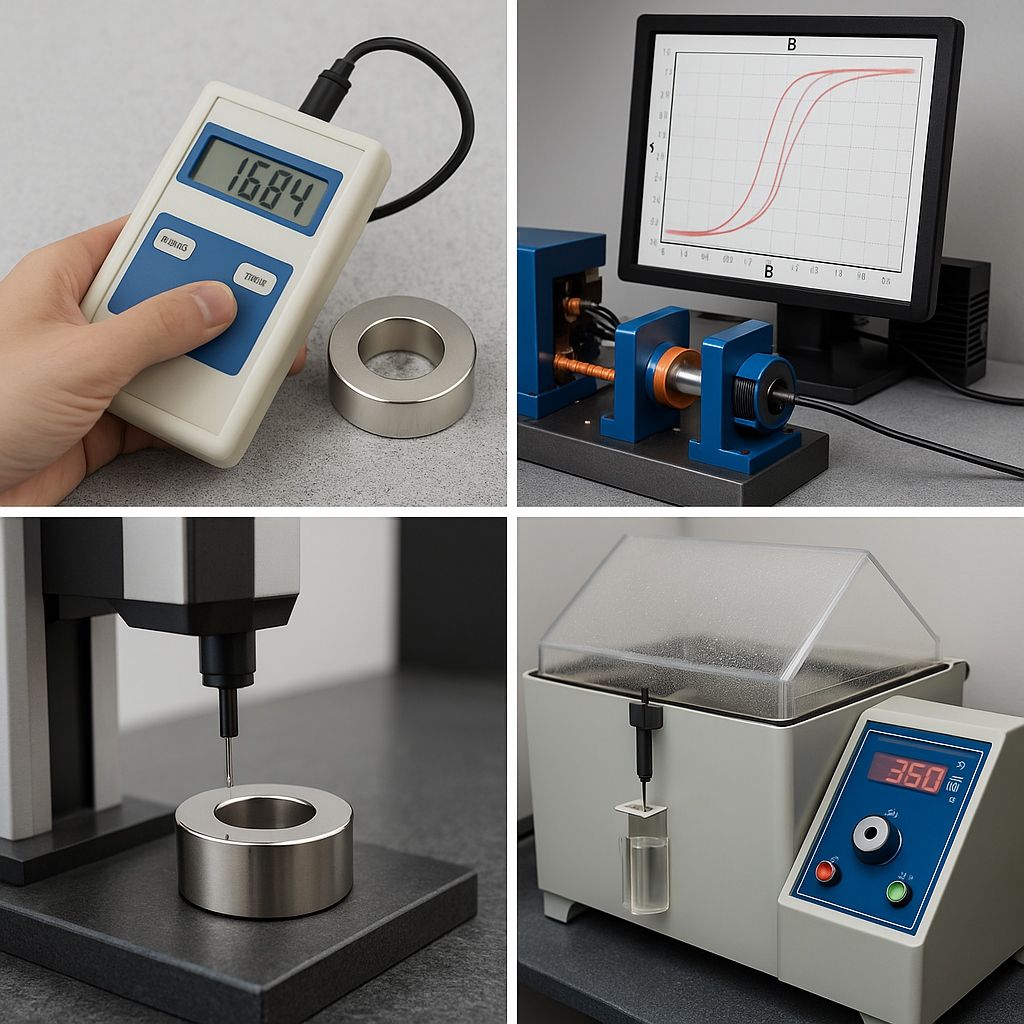
Therefore, precision radially magnetized ring magnets should undergo dimensional inspection and magnetic performance testing during production.
At Jinconn Magnet, custom magnet solutions can be developed according to drawings, samples, dimensions, magnetic requirements, and application conditions. The company's product range includes ring magnets and other NdFeB magnet configurations for motors, sensors, electronics, and industrial applications.
Why Work With a Custom Magnet Supplier?
For brands developing a new motor, encoder, or sensor, selecting a supplier only by magnet price can create problems later.
Instead, the supplier should understand the relationship between magnet geometry, pole count, magnetic performance, assembly tolerance, and application requirements.
Jinconn Magnet provides customized permanent magnets and magnetic assemblies for industrial applications. Its engineering and quality teams can support material selection, magnetization design, dimensional requirements, surface treatment, inspection, and production.
This approach helps customers move from an initial drawing to a production-ready magnetic component with fewer design changes.
Final Considerations Before Ordering
Before purchasing Radially Magnetized Ring Magnets, do not specify the pole count independently.
Instead, start with the motor, encoder, or sensor requirements. Then define the magnetic field pattern, pole count, pole pitch, dimensions, material grade, operating temperature, and allowable tolerances.
If the application requires a special magnetic pattern, a custom multi-pole radially magnetized ring magnet may provide a better solution than a standard ring.
For brands developing motors, encoders, Hall sensors, or industrial automation equipment, Jinconn Magnet can provide customized magnetic solutions based on technical drawings, samples, and application requirements.
The goal is not simply to choose a stronger magnet. The goal is to choose the right magnetization pattern, pole count, and magnetic performance for the complete system.